

Canada's Trade Diversification Is Incomplete Without Africa
Canada’s trade priorities of diversification, critical minerals, infrastructure, and clean energy strongly align with opportunities in African markets, yet Ottawa treats the continent as peripheral.
By: Ayeyi Ohene-Adu

At the last G20 summit in Johannesburg, a journalist asked Prime Minister Carney whether Africa was an economic priority for Canada. His answer was unambiguous. Canada’s focus is on markets with immediate returns, and Africa is not one of them. That reply revealed the mismatch between Canada’s limited trade engagement with Africa and the broader potential for mutually beneficial trade.
Africa accounts for only about one percent of Canada’s total merchandise trade. Despite growth in Canada-Africa trade by nearly 30% over five years, it remains relatively small given the scale of opportunity. Africa houses 30% of the world’s critical minerals reserves. The African Continental Free Trade Area (AfCFTA) would be the world’s largest free trade area by number of countries, with a combined GDP of more than USD $3 trillion, projected to double by 2050. The continent also has one of the world’s biggest infrastructure markets, with annual needs exceeding USD $100 billion and yields up to 20%. These prospects are consistent with Canada’s trade agenda.
Canada has strengths in key sectors across Africa and can connect with many African states through its diaspora and languages. However, it lacks urgency. At the same time, African countries are building their global trade partnerships. By 2034, Africa’s projected trade growth rate with major partners will exceed two and a half percent. Canada’s delay in building stronger trade partnerships with Africa is costing it significant trade revenue potential and partnerships.
Canadian businesses and policymakers often describe Africa as “high-risk” to explain Canada’s limited trade with the continent. This label is reductive and incomplete. If Africa were too risky, it would not be Canada’s second-largest mining region, with CAD $45.9 billion in assets in 2024. This figure shows that Canadian firms enter African markets when incentives are strong and capabilities align. The problem is that this commercial presence remains concentrated in mining, rather than expanding into other sectors where Canada is well-positioned, including agri-tech, clean energy and infrastructure.
Canada’s risk-averse business culture helps explain its narrow trade engagement. This caution is rooted in the country’s economic history and structure. Canada long operated as a branch-plant economy, with U.S. subsidiaries dominating key sectors. This meant major investment decisions, including expansion into other regions, were often made at U.S. headquarters and not in Canada. Also, several major Canadian industries are protected oligopolies, earning stable returns in concentrated domestic markets. This comfort can reduce incentives to compete in less familiar regions. Africa is then treated as unusually risky, even when Canada’s preference for established economic relationships is also at play.
The result is an inconsistent relationship with Africa, shaped more by aid programs than by sustained commercial strategy.
Additionally, the Africa “risk” label often centres on governance and corruption concerns. Business governance practices are important to Canadian companies who must comply with strict anti-corruption laws. Sub-Saharan Africa has the lowest regional average score on the Corruption Perceptions Index, at 32 out of 100. That said, corruption across Africa is neither uniform nor uniquely disqualifying. As shown in Figure 1 below, some African countries score at or above major Canadian trading partners, including the U.S., India, and China. Mexico even scores below the Sub-Saharan Africa average. Yet Canada has not retreated from these markets on governance grounds. Canada should therefore apply the same due diligence and selective engagement it uses in other regions when approaching African markets, beginning with African countries that are most ready for trade partnerships.
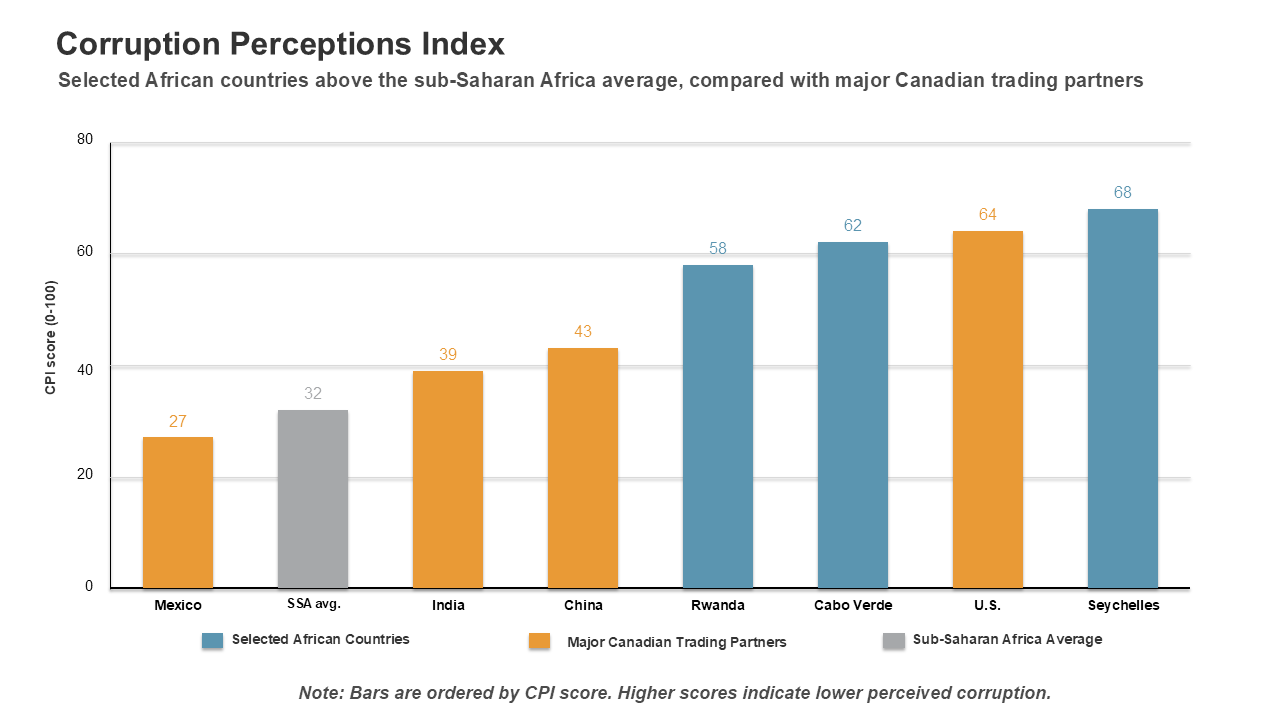
Canadian businesses have also been deterred by concerns over unpredictable supply chains and returns. These are real challenges. Some African countries face security threats that can hamper business operations. Others experience severe currency depreciation, which can make foreign-denominated financing costly. These issues, while valid, are not homogeneous across Africa. Treating Africa as a single risk environment ignores major differences in political stability and economic management across more than 50 countries.
So, what should stronger engagement with Africa look like?
First, any approach must address the potential exploitation that trade can pose to African states. Canada’s Africa Strategy and the Senate Committee study both acknowledge the harms caused to Africa over the years. Trade relations must be grounded in African agency and recognize the unequal and extractive relationships African states have historically faced. The 2020 Nevsun Resources Ltd. v. Araya case, which involved allegations of human rights abuses connected to a Canadian firm in Eritrea, is a reminder that such exploitation may still exist in recent times. Moving forward, future commerce must be mutually beneficial and built on shared trust and respect for African states. A good starting point is to build trade around the African Union (AU)’s Agenda 2063, which outlines the continent’s long-term aspirations and the framework for achieving them.
Canada-Africa trade also requires stronger institutions to help Canadian firms enter and operate in African markets. Canada already has some of those tools, but they are not operating at the required scale. Export Development Canada (EDC), the agency that supports Canadian firms doing business abroad, only has one office in Africa. Africa accounts for less than two percent of its total global business. EDC needs to expand its presence, build closer relationships with African actors, develop tailored risk-sharing products, and invest in stronger market intelligence.
Another organization to enhance is FinDev Canada, Canada’s development finance institution. Although Sub-Saharan Africa accounts for roughly 40% of its portfolio, gaps remain. FinDev needs flexible financing, stronger capital mobilization, more visible work, and clearer alignment with Africa-led priorities. Without a more ambitious role for these agencies, Canadian firms will continue to stay away.
A further significantly underdeveloped investment opportunity for Canada is African infrastructure. Canadian institutional investors, including the Maple Eight, Canada’s eight largest public pension plans with over CAD $2.4 trillion in assets, invest heavily in global infrastructure. However, their presence in Africa is limited. This gap is significant because African governments are building infrastructure value chains with global partners. China-Africa trade alone reached USD $348 billion in 2025. African partnerships with countries offer Canada a practical entry point. As projects mature, gaps are emerging in infrastructure finance, digital systems, clean energy, and agri-tech. Canada has expertise in these areas. So, Canadian firms can join commercially viable projects in Africa through shared-risk partnerships. This model is attractive because it lowers perceived risk and lets Canada focus where it can add the most value.
Lastly, Canada has one substantially untapped advantage: its bilingual identity and African diaspora. English is an official language in roughly 28 African countries, and French in about 21. These languages give Canada a linguistic foundation for widespread engagement. Canada also has a growing African diaspora of 1.4 million people, many of whom are educated and have business experience. That diaspora can be a trusted trade connector and support trade missions. However, the diaspora is not a substitute for local partnerships, especially as diasporans may not fully reflect evolving realities on the ground. Used carefully, however, Canada’s bilingual identity and the diaspora can be economic accelerants.
These critiques do not dismiss the steps Canada has taken to strengthen its relations with African countries. The Africa Strategy, the Standing Senate Committee report, and Canada’s funding commitments to peace, security, environment, and gender equality in Africa all signal the need for more engagement. The concern is whether Canada can act at the speed and scale needed for meaningful trade with Africa. If Canada wants to be globally competitive while building equitable partnerships, it needs to back its strategy with urgency, resources and sustained political will. The slower Canada moves, the harder it will be to build the durable partnerships needed to support its trade diversification goals.