

An Oceanless Future: Reflections on a Transatlantic Journey
Un Futur sans Océan : Réflexions d’une traversée transatlantique
As a policy publication, we tend to focus on analysis, evidence, and opinion. But every so often a piece comes along that reminds us why policy work is rooted in human experience, emotion, and conviction. This piece departs from our usual format, yet it speaks directly to the motivations that bring many of us to this field. We chose to publish this poem because it reminds us that policy is not only technical; it is also an expression of what we value, what we hope to protect, and what we refuse to ignore.
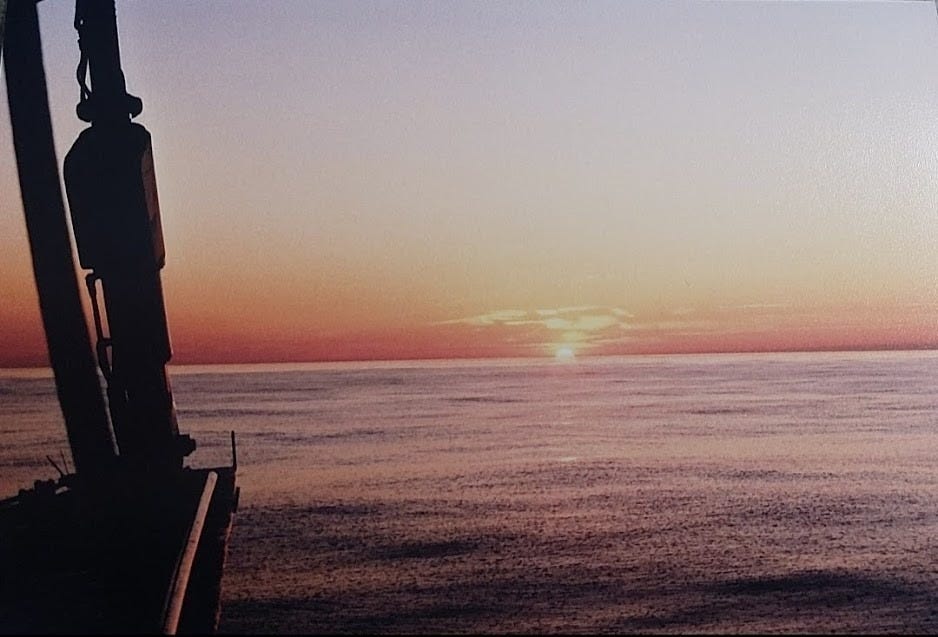
I came to Canada on a sailboat. I was not sailing myself. I was simply on a boat that sailed across the Atlantic from France, on my way to study public policy. Transportation is one of the most polluting sectors in the world; as global warming and the climate crisis advance steadily, it is vital to rethink how we travel. I believe that policies are most successful when the people who design and implement them actually care. Taking to the sea was a way for me to experience the reality of decarbonized travel.
Aboard the sail-cargo ship, I had the unique opportunity to enter the small world of the merchant marine and befriend the sailors. On board, I saw their reverence for the ocean, shared their humility in deference to the elements, and felt their sensitivity to the wildlife we met on the way. I was deeply touched by their peculiar approach to life and their immense respect for Mother Nature. One day, I asked the captain if he had ever thought that the sea was alive. “Oh,” he said, after a pensive silence, “she is alive.” His words, and my discussions with the other sailors, have inspired the following lines.
Original version (French)
Il y a quelque chose de mystique à l’Océan. Quand on n’y est jamais allé, on est tenté de se dire qu’il ne s’agit que d’une vaste étendue d’eau, un désert salé et sans fin où l’on est effroyablement seul. En réalité, c’est tout l’inverse.

Ne serait-ce qu’à la surface de la mer, les dauphins aiment jouer avec les bateaux et saluer leurs habitants. Plus loin, on peut voir le souffle d’une baleine percer l’horizon, fontaine majestueuse. La nuit, on s’émerveille du spectacle stellaire du plancton bioluminescent. Un marin m’a un jour parlé d’une nuit onirique où, au clair de lune, il a vu un dauphin nager dans un banc de ces plancton éclatants et sauter hors de l’eau, avant de disparaître dans les profondeurs. Un autre, plongeur, m’a quant à lui raconté avoir déjà nagé avec une dizaine d’espèces différentes de requins. Il navigue autour du monde en quête de ces face-à-face magiques. « Chaque rencontre avec un poulpe laisse un souvenir unique et précieux », m’a encore confié une amie.

Méconnues, les profondeurs sous-marines abritent des espèces aux formes et couleurs toutes aussi variées qu’elles paraissent être tirées d’un rêve. Jusqu’à sa dernière goutte, la mer est pleine de vie. Mais l’Océan, gigantesque, est peut-être lui-même vivant, la puissante houle, son cœur battant, les vagues, ses cris de vitalité, et l’écume, son souffle endormi. Peut-être est-ce la transcendance de ces vies qui crée le mystique de l’Océan. Entre celles qu’il abrite et la sienne, un Titan bienveillant.

Pourtant, Océan se meurt. Gavé au plastique, empoisonné de produits chimiques, suffoquant sous le dioxyde de carbone, Océan se meurt. Se démenant pour sa propre survie, il doit assister impuissant, au massacre de ses pupilles.

Les majestueuses baleines sont couvertes de cicatrices, scarifiées encore et encore par le passage des bateaux et de conteneurs à la dérive. Les dauphins, autrefois si joyeux, pleurent désormais leurs proches pris dans des tueries de masse, car en mer la Mort ne vous poursuit pas avec une faux mais avec un chalut. Les planctons, jadis aussi nombreux que les étoiles dans le ciel, aujourd’hui périssent, leur corps se dissolvant littéralement dans l’acidité des eaux. Les malheureuses créatures assez chanceuses pour survivre subiront la famine et la destruction de leur monde.

Océan se meurt, et tous, meurent avec lui.

Quand notre Gardien disparaîtra, quand la mer ne sera plus rien sinon un désert sans fin de plastique et de sargasses, quand toute la vie sera morte, que restera-t-il de nous, à la surface ?
Translated version (English)
There is something quite mystical about the ocean. One who has never been there might be tempted to think that it is nothing more than a vast expanse of water, endless—a salted desert where one is appallingly alone. In reality, it is just the opposite.

At the surface of the sea, dolphins like to play with ships and greet their inhabitants. Further away, one can see the blow of a whale piercing the horizon, a majestic fountain. At night, one is entranced by the stellar sight of bioluminescent plankton. A sailor told me once about a dreamlike night under the moonlight. He saw a dolphin swimming through a shoal of these shining plankton and leaping above the water, before vanishing into the depths. Another, a longtime free-diver, shared his experiences swimming with more than a dozen species of sharks. He sails around the world looking for these magical moments face-to-face with the sea. Another friend confided that “each encounter with an octopus leaves behind a unique and precious memory”.

Little-known, submarine depths shelter species dressed in variegated shapes and colours, as if they were born from a dream. To its very last drop, the sea is full of life. But the Ocean, gigantic, may herself be alive, the powerful swell her beating heart, the waves her bursts of vitality, and the foam her lethargic breath. Perhaps it is the transcendence of these lives that creates the Ocean’s mystique. Between those she shelters and her own, a kind and caring titan.

Yet, the Ocean is dying. Force-fed with plastic, poisoned with chemicals, suffocating with carbon dioxide, she is dying. Fighting for her life, the Ocean is forced to watch the massacre of her wards.

The majestic whales are covered in scars, cut again and again by the passing of ships and fallen containers. The once-joyful dolphins now mourn their loved ones caught in mass slaughters, because at sea, Death doesn’t chase you with a scythe but with a trawl net. Plankton, which were once as numerous as the stars in the sky, now perish, dissolved in acid waters. The poor creatures lucky enough to survive will suffer from famine and the destruction of their world.

The Ocean is dying, and all are dying with her.

When our Guardian will pass away, when the sea will be nothing more than an endless desert of plastic and sargassum—when all life has died, what will remain of us, at the surface?


A note from the editorial team
As we close out our final publication of the year, we want to thank all of our readers, contributors, and supporters for engaging with our work. Your interest and enthusiasm have shaped this newsletter into a space for thoughtful policy reflection. We wish you a restful and joyful holiday season, and we look forward to bringing you new ideas, fresh perspectives, and compelling pieces in the new year.