

Transit Should Work for Everyone in Canada
Public transit is meant to connect people, yet today it’s pushing many riders out with costs and barriers they can’t overcome.
By: Madina Shahab
Last year, I was taking the 129 Toronto Transit Commission (TTC) McCowan North bus from Scarborough Centre Station. It was raining and windy—Toronto is known for its harsh winds. At every stop, the bus became more crowded.
I was sitting behind the driver, watching people get on and tap their cards. A woman who looked very cold tried her card twice. It didn’t work. She checked her pockets and found only a few quarters.
She looked at the driver and then got off the bus to walk to her destination, already soaked from the rain. Likely, she was an immigrant, and her situation suggested a low income and a language barrier.
A single TTC fare costs $3.35 for an adult. For youth aged 13-19, it is $2.40, and $2.30 for seniors aged 65 and older. There are fare discounts programs, but the application process is complicated and time-consuming. The City of Toronto oversees the application process, which can take several weeks. Many applicants report delays and requests for missing documents that restart the process.
Adding to the challenge, eligibility has to be re-proven every year. For people without internet access or who struggle with online forms, the limited in-person support makes the process even harder.
Public transportation is a basic necessity. It connects people to school, work, and essential services. Yet, in major Canadian cities like Toronto, Ottawa and Montréal, public transit has become costly and unaffordable for low-income families.
In Montréal, the Société de transport de Montréal (STM) fare costs $3.75 per ride, or about $100 for a monthly pass; that is $1,200 a year to get to work, school, or anywhere else. For many people, that’s a serious financial burden.
And it reveals a deeper problem: our public transit systems have become barriers instead of bridges.
Why did that woman choose to walk in the rain? Maybe she needed that money for groceries, rent, or medication. Maybe she simply couldn’t afford the fare. But she shouldn’t have had to make that choice. No one should choose between riding the bus and meeting their basic needs.
When you see people forced into those decisions, it becomes impossible not to realize that something is deeply wrong. We are not on the right track with public transportation.
Fare-based systems assume that everyone can afford to pay to use a public system. However, many low-income riders fall into the ‘in-between’ space: they earn slightly too much to qualify for assistance but not enough to comfortably afford daily transit. And even when they are eligible, the system often feels out of reach, especially for newcomers and people without reliable internet access.
This “everyone pays” policy looks fair on paper, but it fails in practice. The most—paperwork, documentation, and digital access—is asked from those who have the least.
The cost of excluding people from transit is high. When people can’t afford to access public transit, they may skip medical appointments, lose social connections, or miss work. A city that prices people out of mobility ends up paying for it in other ways: public health costs, lost productivity, and deepening inequality.
So, what can we do? Let’s rethink how we view and fund public transportation.
According to the TTC’s 2025 Operating Budget, almost half of its operating money, about 42%, or $1.386 billion, comes directly from passenger fares and other rider-generated revenue. The remaining operating subsidy, $1.387 billion, comes from the City of Toronto which has far fewer ways to raise money compared to provincial or federal governments.
The federal government contributes zero percent to TTC operating costs, and the provincial government provides only about seven percent, even though both levels of government have far greater revenue tools and responsibilities for transportation, climate goals, and regional mobility.
This funding structure makes the TTC behave and operate like a business: when ridership falls, so does revenue. That leads to fare hikes or service cuts, changes that hurt those who rely on it most.
Instead of treating it as a business, we should treat it like any other essential service: a public good that benefits everyone. Investments in hospitals, public schools, and other essential services are considered public investments because they make communities stronger, healthier, and more connected.
Transit does the same thing. It reduces congestion, cuts pollution, and boosts local economies by connecting workers to jobs and customers to businesses. It is, quite literally, what keeps cities moving.
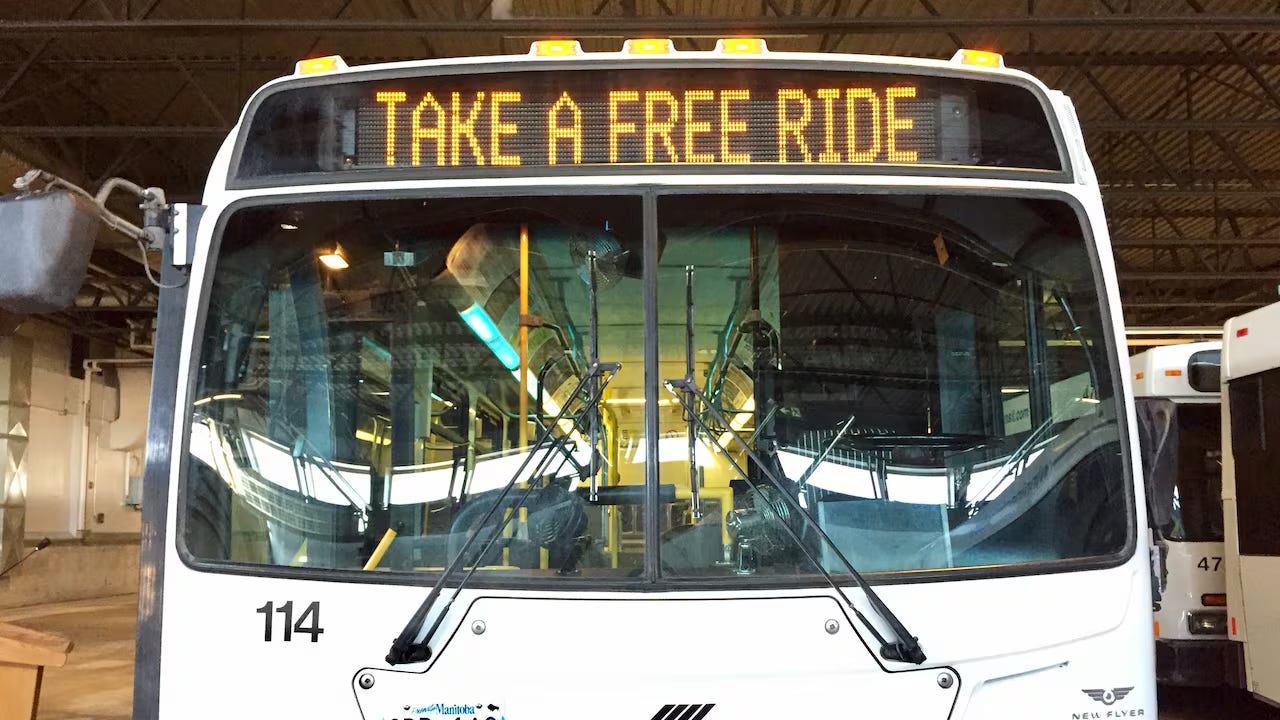
A shift toward fare-free or truly low-fare transit isn’t impossible. Cities and towns around the world – and even in Canada – have shown it can work. For instance, Orangeville, Ontario, a town northwest of Toronto with a population of around 30,000, made transit free for everyone.
Before Orangeville introduced its fare-free transit program, the town had about 102,898 riders in 2019. After the program began in 2023, ridership grew dramatically to 225,705 riders. That is an increase of 119%. The success of the program led the town to extend it until mid-2027. It is funded through the municipal budget and provincial gas-tax support.
Orangeville’s Mayor, Lisa Post, said several people who rely on the local food bank told her that free transit allows them to save enough to buy essentials like bread and milk.
Critics often ask, “who will pay for it?” But the real question is: who is paying now? We are. We pay through traffic gridlock, missed medical appointments, and lost productivity.
That’s why all levels of governments must commit to long-term, stable funding, so transit can operate as a dependable public service, instead of a system driven by fare revenue. This means the provincial and federal governments must provide direct annual operating contributions, just as they already do for essential services such as schools, hospitals, and long-term care. Municipal systems like the TTC or Montréal’s STM cannot bear these costs alone.
This doesn’t mean that the government needs to raise new taxes. They can use existing revenue sources that provincial and federal governments already collect. Unlike municipalities, they have multiple large revenue streams, including income tax, sales tax, and corporate tax. Allocating a portion of these existing revenues to transit would provide stable operating funding without placing the burden on riders.
Of course, relying only on government funding has its limits. Budgets are tight, priorities have changed, different levels of government share fiscal responsibility, which can slow decisions and make funding uncertain.
Big cities like Toronto or Montréal need far more money than small towns, making it harder to scale up fare-free transit. And those buses need funding for maintenance, fuel, and workers. But these challenges don’t make fare-free transit impossible. They just signal that it must be planned carefully, prioritized, and supported with steady funding and cooperation between all levels of government.
Give her a ticket to ride. The Beatles said so!